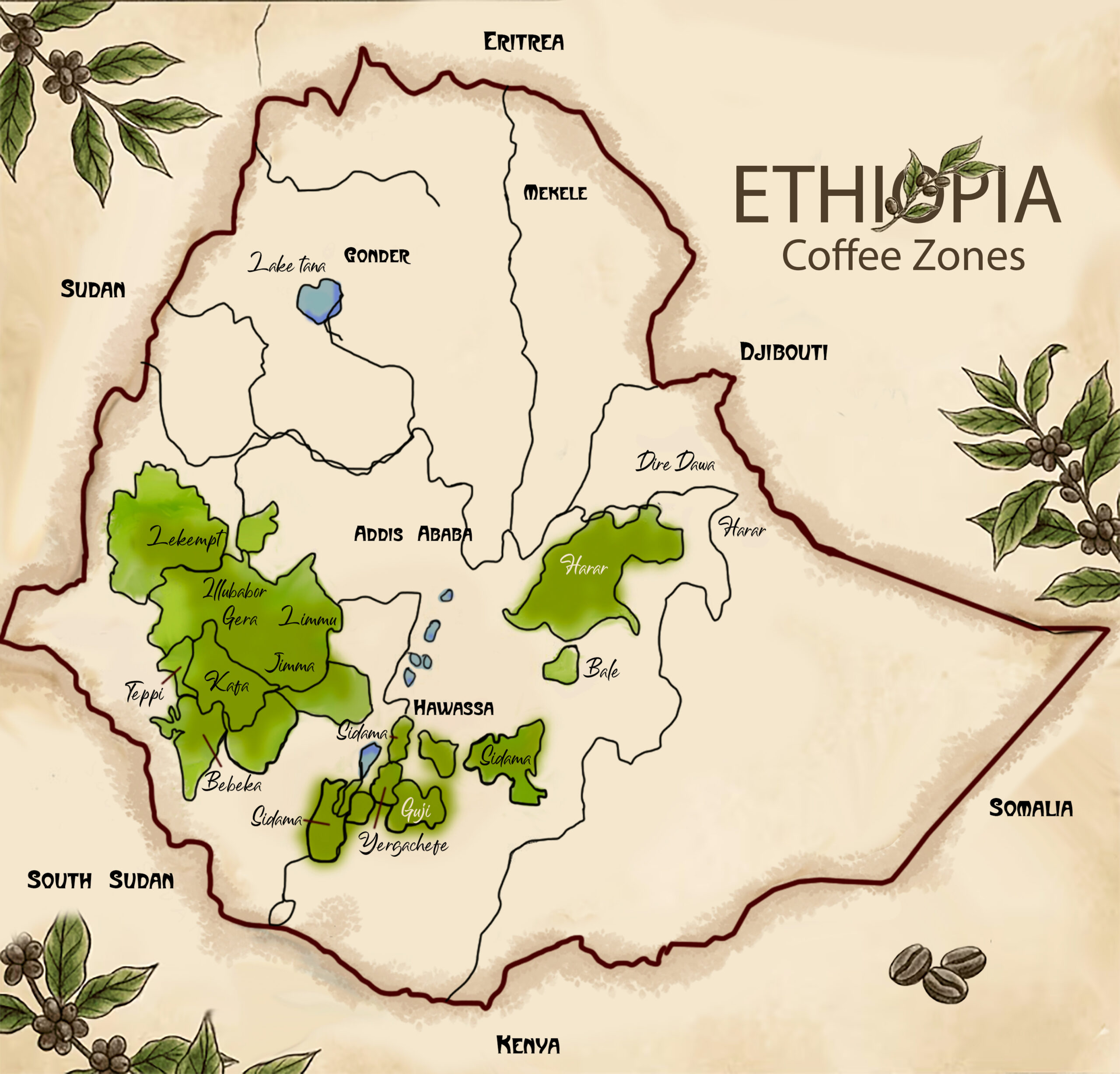
Ethiopia’s ancient coffee forests represent one of the world’s most unique coffee-growing environments. These forests, particularly in regions like Sidamo and Yirgacheffe, have cultivated coffee trees naturally for centuries, contributing to the genetic diversity and distinct characteristics of Ethiopian coffee.
Ethiopia’s rich coffee heritage stretches back more than a millennium, making it not just the birthplace of coffee but also home to some of the world’s most sought-after coffee beans.
Ethiopia’s Coffee belt
Ethiopia’s coffee belt lies between 6-10°N latitude and 35- 40°E longitude. The tropical climate and high elevations are ideal for Arabica cultivation. Rainfall is moderate and occurs in one main rainy season from June-September.
The Distinct Growing Regions of Ethiopia Coffee Ethiopia’s diverse landscape and climate create ideal conditions for coffee cultivation, with each region producing beans with unique flavor profiles and characteristics. Ethiopia has three main coffee growing regions:
The Distinct Growing
Regions of Ethiopia Coffee
Sidamo: Complex and Full-Bodied
The Sidamo region produces Ethiopian coffee known for its complex flavor profile, featuring wine-like acidity and full-bodied taste. Sidamo – Known for its balanced, sweet, and complex coffees with notes of berry and citrus. These beans often exhibit notes of blueberry and dark chocolate, making them highly sought after by specialty roasters.
Yirgacheffe: The Crown Jewel
Yirgacheffe Ethiopian coffee beans are renowned for their floral and citrus notes, often described as having jasmine, bergamot, and lemon undertones. The high-altitude growing conditions and specific processing methods contribute to these distinctive characteristics.
Harrar - King of Ethiopian Coffee
Harar was considered the king of Ethiopian coffee, for a prized aspect called “Mocha flavor” by local traders. Produces wild, naturally-processed coffees with a wine-like acidity and dried fruit notes. Beans are grown in an arid climate at lower elevations than other regions.
Limu
Has coffees with a spicy, winy acidity and a long-lasting, pleasant aftertaste. Beans feature a medium-heavy body and are grown at elevations ranging from 3,600-6,200 feet.
Limu
Has coffees with a spicy, winy acidity and a long-lasting, pleasant aftertaste. Beans feature a medium-heavy body and are grown at elevations ranging from 3,600-6,200 feet.
Guji - Buku
Buku is a well-regarded coffee-growing region in Ethiopia, specifically within the Guji Zone. Buku is known for its high-altitude coffee production, with some farms reach- ing up to 2,350 meters above sea level. The Buku region is known for its dry-processed natural coffees, and some are also processed using an anaerobic fermentation method. Like many coffee-growing regions in Ethiopia, West Guji is incredibly diverse, with unique cultural practices and tradi- tions that vary from woreda (district) to woreda.